
Inside DERIVA: How a Sound Becomes a Memory
A journey through Fracture, the Engines, The Keeper and the Archive.
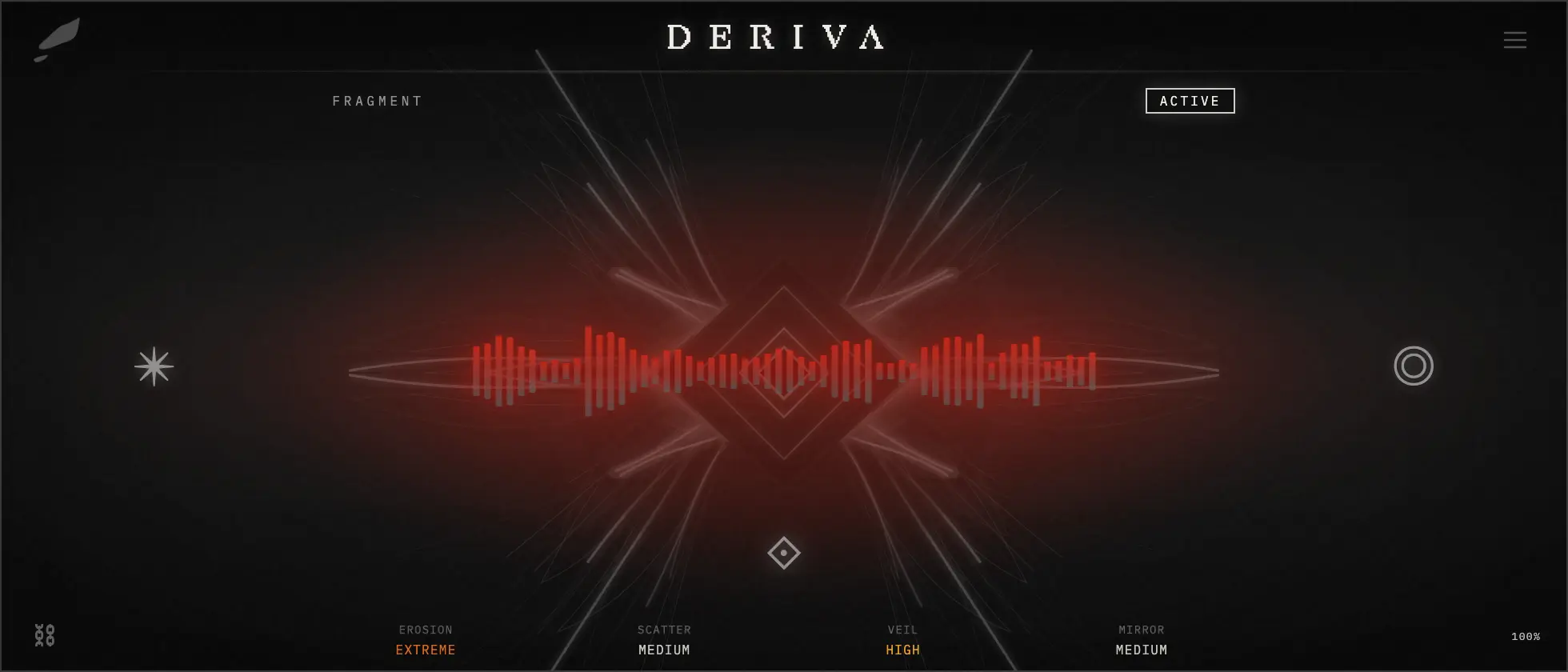
A sound enters DERIVA before it has a name.
It may be a vocal, a drum loop, a synth, a guitar or an entire bus. At first, nothing has happened to it. There is no preset promising a finished destination and no list telling you what to hear.
There is only the source and the possibility that another version of it is waiting nearby.
DERIVA begins there: not with an answer, but with an invitation to listen.
Fracture begins without a destination
Pressing Fracture creates a new Fragment. A Fragment is not captured audio and it is not a conventional preset. It is a generated processing state applied to the live signal passing through the plugin.
Behind the interface, Fracture gives each Engine its own coherent set of values and decides how the four Engines relate to one another. Their order can change too, because damage before space is not the same as damage after space.
The generated state must remain musically usable, but it should not feel like a minor variation of the last one. DERIVA compares valid possibilities and favours a result that is perceptually different from recent discoveries.
When one Fragment gives way to another, the complete processing chains crossfade. Grains, filtered movement and reverb tails can leave naturally while the next state grows into the signal.
The technology is there to protect the interruption. Fracture should feel immediate, but the sound should not be torn apart by the act of finding the next one.
Four Engines meet the same source
Every Fragment passes through four Engines. They are not four genres of preset. They are four ways of asking what else the source could become.
Erosion works on the surface. Saturation, drive, tone damage and spectral pressure can make the signal warmer, thinner, brittle or severely worn. At low Mix values, even an extreme state can survive as a trace.
Scatter works on continuity. It divides the signal into grains, changes their length and density, spreads them through time and stereo space, and can displace fragments in octave steps.
The source may remain recognisable, but its timeline stops behaving as one uninterrupted object. A note becomes a cloud. A transient leaves particles behind.
Veil works on what is revealed. Moving filters, resonance and spectral colour open and close around the source. It can hide the body, expose a narrow harmonic edge or make the sound breathe without obvious modulation.
Mirror works on what follows. Reverse bloom, shimmer, diffusion and a wide ambient field turn the end of a sound into another beginning. Space stops being a background and becomes part of the event.
Each Engine displays a tag such as Trace, Medium, Extreme or Singularity. The tag describes the audible strength of the Engine, not one isolated parameter.
You can mute, solo and reorder the Engines. You can keep the order locked while Fracture changes their states, or preserve muted Engines across new Fragments. DELTA lets you hear only DERIVA’s contribution.
There is control, but it arrives after discovery. The first question is not “which value should this knob have?” It is “what is this sound trying to become?”
A Fragment belongs to the present
Once generated, the Fragment remains active. It processes whatever audio reaches that instance of DERIVA, and the DAW session remembers it.
That does not make it part of the Archive.
The distinction matters. A Fragment can be useful, beautiful or strange without immediately becoming permanent. It is allowed to exist only in the present session while you decide what it means.
Modern creative work makes saving effortless. Versions multiply. Folders fill. The fear of losing a possibility can become stronger than the attention given to the possibility itself.
DERIVA separates hearing from keeping.
Offer makes saving an act
When a Fragment feels worth carrying forward, you do not press Save. You press Offer.
Offer submits the active Fragment to The Keeper. It is a small change in language, but it changes the emotional weight of the action. Saving usually assumes ownership. Offering admits uncertainty.
The Fragment may be Preserved. It may be Lost.
This uncertainty is not a judgement of whether the sound was objectively good. The Keeper does not understand the song, and it does not know your taste. Its purpose is to make the decision irreversible enough to be felt.
The Keeper remembers balance, not taste
The Keeper begins at an even 50/50 chance between Preserved and Lost.
It is not a perfectly forgetful coin. Repeated Lost results make a future Preserved result slightly more likely. Repeated Preserved results gently pull the other way.
The shift is subtle and capped. The outcome never becomes certain, and no sequence can turn The Keeper into a reward machine.
Its aura hints at the current tendency: a pale bloom leans toward preservation; a deeper red leans toward loss. It suggests, but never promises.
This balance prevents two kinds of numbness. Endless loss would make offering feel pointless. Endless preservation would reduce it to an ornamental Save button.
The Keeper exists between those extremes, where hope and risk remain present together.
Preserved and Lost are both movement
If the Fragment is Preserved, it becomes a Remnant in the Archive. The generated Engine states, order, mutes and identity can be recalled later.
If it is Lost, the Fragment disappears. The source audio remains yours and the plugin continues, but that particular possibility is gone.
Lost is not a punishment screen. It clears the space for another Fracture.
Sometimes the next discovery is better. Sometimes it is not. Sometimes losing one sound makes you realise what you valued in it. That knowledge follows you even when the state does not.
Not everything worth hearing needs to become an asset. Some sounds do their work by passing through.
The Archive becomes a portrait of attention
The Archive does not grow because Fracture was pressed many times. It grows because certain Fragments were offered and survived.
Every Remnant can be named, favourited, searched, filtered and recalled. Vessels such as Vocals, Drums, Pads, Atmos or Ruined can organise material without altering the sound itself.
Several views let the same memory be read differently.
All and Fav provide direct recall. Field places Remnants between grounded and spatial, subtle and intense. Stars groups related discoveries into constellations.
Compass organises them by dominant Engine character. Line reveals connections created through Morph, so later sounds can retain a visible relationship with what came before.
Statistics remain local and describe the Archive as a creative history: how often you Fracture, what survives, which Engine dominates and which kinds of sound repeatedly catch your attention.
Milestones quietly mark the Archive’s development. They are not a public score. They are signs that a personal vocabulary is taking shape.
A factory bank records the taste of its designer. Your Archive records yours.
Memory can be changed, combined and risked again
A preserved sound does not have to become untouchable.
Select a Remnant and enable Morph. The Remnant stays attached while Fracture introduces a new generated state. The active result, called Flowing, is an equal meeting between remembered and unknown.
If that hybrid is Offered and Preserved, it becomes a Morphed Remnant. The Archive remembers its lineage, allowing the relationship between source and result to remain visible.
Morph also restores risk to a memory that once survived. A Lost Morph Offer can leave the source Remnant Scarred, reducing how much it can shape the signal. Repeated scars can make it Extinct.
Extinct does not mean erased. The Remnant remains in the Archive as memory, but it can no longer act with the same force.
Merge approaches memory differently. Two to four Remnants can be joined into a new Merged Remnant. The sources are hidden rather than destroyed, and Sever can restore them.
Morph asks what a memory could become. Merge asks what several memories might say together.
The interface leaves some things unnamed
DERIVA exposes broad actions, Engine identities and audible tags, but it does not turn every internal value into a front-panel control.
That is deliberate. A dense matrix of parameters would make exact programming the centre of the experience. DERIVA is built around recognising a result, shaping it and deciding whether it should remain.
The unknown is bounded. The Engines have defined roles. Fragments can be muted, soloed, reordered, mixed and recalled. The process is exploratory, not arbitrary.
Trust does not require surrendering all control. It requires leaving enough space for the sound to answer back.
What DERIVA is really preserving
Months later, two people using the same plugin will not have the same Archive.
They may begin with the same Engines and the same probability, but they will send different sources, interrupt different Fragments and Offer for different reasons. Their losses will redirect them differently too.
The result is more than a collection of effect states. It is a record of attention.
What made you stop? What did you risk? What survived? Which colours returned often enough to become part of your language?
DERIVA does not promise that every Fracture will be useful. It asks you to stay available to the one that might be, and to accept that finding it may require letting another one pass.
Some things are worth keeping. Others are meant to pass.
Explore DERIVA and hear Fragments shaped from different sources.
A generative texture processor for degraded movement, atmospheric detail and playable sound-design accidents.